Our article breaks down Hacksaw Gaming’s Stack ’Em, the high-volatility cluster-pay sequel starring Canny the Can, covering RTP options, bonus-buy value, bankroll tips and why Canadian casinos keep it in their “Hot” tabs.
Canny the Can’s return
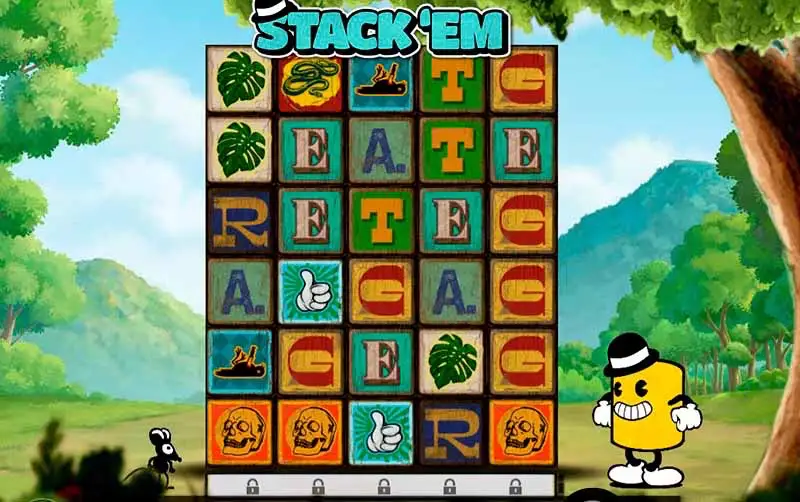
Hacksaw Gaming knew exactly what it was doing when it brought Canny the Can back for a second act. Players who spun Stick ’Em in 2019 remember the little tin mascot whistling and fist-pumping with every win. That throwback cartoon energy now sits on a bigger stage, a 5 × 6 grid that replaces paylines with cluster payouts and chain reactions. The visual style borrows from early Fleischer Studios shorts, thick black outlines, muted greens, exaggerated bounce, yet everything is rendered in slick HTML5, so the game loads crisp on a 4K monitor as easily as it does on a mid-range Android.
Because the mechanic changed so drastically from lines to clusters, the personality of the slot shifted too. Stick ’Em felt light, almost cosy. Stack ’Em is louder, sharper, and a whole lot meaner. The animations sell that difference: when the reels go dead, Canny frowns, slumps, and slaps the side of the grid in frustration. When multipliers climb, the same can morph into a hype man, waving players onward like a cornerman urging a fighter. The effect is subtle but keeps sessions from feeling static, an important quality for long grid-slot grinds.
Canadian casino lobbies noticed. Mr.Bet lists Stack ’Em beside Wanted Dead or a Wild and Gates of Olympus in its “Best for Risk-Takers” carousel. NeedForSpin rotates it into the “Hot Right Now” banner any time Hacksaw runs networked prize drops. Both operators track on-site search queries and confirm that Stack ’Em sits in the top 20 terms week after week, even three years post-launch. A sequel that maintains this sort of traffic has clearly struck a chord with northern punters.
Math model and volatility
Hacksaw published Stack ’Em with a headline RTP of 96.20 percent, which is bang on average for modern high-variance slots. The studio also certified 94.16 and 92.20 percent editions for venues operating under heavier tax or rev-share models. If you play in Ontario’s regulated market, the displayed figure must match the lab-tested certificate, so you will always see 96.20 percent at Caesars Palace Online, BetRivers, and the rest of the iGaming Ontario roster. Offshore casinos select whichever version fits their margin, so a quick peek at the info menu saves you several theoretical points of return over the long haul.
Volatility sits at the studio’s maximum five-skull setting. That label is not marketing bluster. The average hit frequency clocks in at 10.56 percent, or roughly one successful cluster every ten spins. The model compounds danger by pairing that low hit rate with a 10,000 × max win. In other words, most of the RTP hides in enormous but extremely rare payouts. Players should expect stretches of twenty or thirty blanks even on a sensible $1 stake, punctuated by the occasional tumble that jumps the balance forward 50× or 100× in seconds.
Mathematically inclined grinders often compare this curve to Hacksaw’s own Chaos Crew. On paper, the games share the same ceiling, yet Chaos Crew lands wins twice as often. The price you pay for Stack ’Em’s beefier reel multiplier system is punishing dry spells. That trade-off becomes very clear on the first session, so bankroll management is not optional here.
Cluster multipliers and bonus mechanics
Stack ’Em’s engine relies on three interacting features. Understanding how they weave together turns random spins into a coherent game plan.
First, the base game uses reel multipliers. A winning icon that settles on the bottom row adds +1 to the numeric booster drawn beneath that column. Those six values combine and apply to the very next winning tumble. With enough patience, you can land a moment where five or six columns show 5× or 6×, producing a 30× swing multiplier without leaving the base game. Because multipliers reset after any losing cascade, timing becomes everything. Many seasoned players drop the turbo speed once two or three columns hit 4×, hoping to savour a big reveal if the next icon connects.
Second, the free-spin round converts lives into pacing tools. Three, four, or five scatters award five hearts. Each losing cascade removes a heart, each winning cascade keeps all remaining lives intact. This structure differs from traditional fixed-spin bonuses where a blank is harmless. Here, blanks actively bring the round closer to its end, injecting tension into every single tumble.
The third element, and the one streamers obsess over, is the symbol pair that modifies the feature:
- X Symbol: multiplies the value of any connected cluster by the running global multiplier.
- ? Symbol: either adds 2–5 hearts, increases the multiplier by 1–50, or multiplies that multiplier by 2–5×.
Because the global multiplier never resets inside the bonus, an early ? that doubles the value or an X that lands when the multiplier sits above 100× can catapult the round into table-clearing territory.
Many dot-com casinos offer a 129× bet shortcut to buy the bonus outright. The purchase guarantees five hearts but does not guarantee profit, community spreadsheets peg the long-run expected return around 95 × bet. That is below the cost of entry yet well within confidence intervals for high-variance modelling. Recreational Canadians therefore treat the buy like a raffle ticket: worth the punt when the balance sits high, dangerous when the wallet is thin.
Critics and streamers’ reception
Critical reception of Stack ’Em has remained remarkably stable since launch. Bigwinboard’s original review labelled the slot “cute on the outside, lethal on the inside,” and most outlets echoed that assessment. Online-Slot rated it four stars, praising the clear graphics and 10,000 × potential while docking points for the sub-11 percent hit rate. SlotBeats highlighted the soundtrack, a looping jazz riff recorded with a live brass section that grows louder as multipliers climb, rare production value for a 2021 release.
The streaming scene amplified those talking points. In July 2023, Kick streamer Syztmz pulled a $72,978 win on a $10 stake when an X landed beside a 215× running multiplier. That clip still circulates on Canadian slot Discords, where viewers paste “CANgang” emotes whenever someone loads the game. Similar highlight reels from Roshtein and Xposed, two streamers with large Canadian audiences, keep the slot visible on Twitch’s Slots category.
Visibility translates to lobby placement. Mr.Bet reports that returning players who trigger one natural feature are 22 percent more likely to launch Stack ’Em again within seven days compared to their average retention metric. NeedForSpin noticed a spike in time-on-page whenever the site bundles the game into a weekend wager race, indicating the slot’s volatility pairs well with leaderboard formats that reward big-multiplier screenshots.
Slot terminology
Grid slots come with jargon that differs from the five-reel line games most Canadians cut their teeth on. Brushing up on the vocabulary smooths the learning curve and helps you spot real value when it appears.
We will unpack five core terms, then circle back to how they interact during live play.
- Cluster Pay: five or more identical symbols touching horizontally or vertically. Diagonals do not count.
- Reel Multiplier: a numeric value displayed under each column in the base game, summed after a win, then applied to your next cluster.
- Heart: one life in the free-spin feature. A losing cascade pops a heart, a winning cascade preserves hearts.
- X Symbol: appears only during the feature and multiplies the connected cluster by the running global multiplier.
- ? Symbol: mystery tile in the feature that adjusts hearts or the multiplier in one of three ways.
When you watch a live stream and hear “Need an X now,” the streamer is begging for the X symbol to connect after the multiplier has grown. Conversely, shouts of “Save me!” refer to the ? symbol adding extra hearts when the count drops to its last life. Master these cues, and you will follow the action without looking at the paytable every two minutes.
Knowing the terms also helps with session pacing. A base-game reel multiplier sitting at 1-1-1-1-1-1 holds no edge: step away for a break. Spotting three columns at 5× flips the situation: keep spinning, you are on the verge of a potential 30× board.
Bankroll and spin strategies
Stack ’Em’s temperament resembles a yo-yo. The worst possible approach is chasing losses with bigger bets because the game rarely sprinkles small consolation wins. Instead, regulars follow structured staking patterns that absorb variance while leaving room for the 10,000 × dream.
Most cautious: the Flat 0.2 percent plan. Bet 0.2 percent of your total bankroll per spin. A $1,000 roll means $2 spins, enough to feel dopamine without risking catastrophic damage.
Intermediate: the Step-Down ladder. Begin at 1 percent stakes. If balance falls 25 percent, cut the stake in half. Climb back to the original level only when balance recovers.
High-roller: the Bonus-Bucket method. Ring-fence 150× your base stake purely for feature buys. Fire a single 129× buy, keep the leftover as a buffer. If the bonus returns less than 25× stake, halt purchases for the session.
These structures do not beat the house, but they do prevent panic. Once the mind starts mapping every losing cascade to the weekly grocery bill, decision quality nosedives. A pre-planned stake shield removes that emotional sting and lets you enjoy the artistry Hacksaw built into the tumbles.
Specs comparison
Background context helps players decide which Hacksaw title matches their mood. Before the table, consider that all three slots share hand-drawn aesthetics, yet their math profiles serve different appetites.
| Slot | Layout | RTP (top) | Hit Freq | Volatility | Max Win | Bonus Buy |
|---|---|---|---|---|---|---|
| Stack ’Em | 5 × 6 grid, clusters | 96.20 % | 10.56 % | 5/5 | 10,000 × | 129 × |
| Chaos Crew | 5 × 5 reels, 15 lines | 96.30 % | 23.40 % | 5/5 | 10,000 × | 129 × |
| Stick ’Em | 5 × 4 reels, 1,024 ways | 96.10 % | n/a | 3/5 | 2,048 × | n/a |
Observations after the table matter more than the raw numbers. Chaos Crew hits twice as often, so balance swings feel less punishing, but its base game lacks the reel-multiplier fireworks that make Stack ’Em so theatrical. Stick ’Em offers a gentler ride altogether, capping out around 2,000 × and featuring plenty of 5–10 × line wins that trickle-feed the balance. In practice, many Canadians rotate among all three: Stick ’Em for casual commuting, Chaos Crew for mid-roll evenings, Stack ’Em when they have time and patience for a potential marathon.
Canadians playing under AGCO compliance
Canada’s gambling landscape is complicated: provinces run different regulatory frameworks, yet suppliers must respect them all. Hacksaw Gaming secured an AGCO supplier licence in 2022 and has since widened its Ontario footprint by signing distribution deals with BetRivers, 888casino, and Caesars Digital. Any version of Stack ’Em you load inside the “.ca” walled garden must match the exact RTP percentage on file at iGaming Ontario’s testing lab. That transparency makes the province a safe sandbox for cautious newcomers.

100% + 200 spins
5% - 15% Cashback

100% + 100 spins
Up to 225% + 180 FS on first 3 deposits

110% + 120 spins
Up to C$2,900 + 290 FS on first 4 deposits

150% + 70 spins
400% Bonus on first 4 deposits + 5% cashback

100% + 150 spins
Up to 255% + 250 FS on first 3 deposits
Outside Ontario, Canadians spin under the soft oversight of Kahnawake or purely offshore licences such as Curaçao. Mr.Bet and NeedForSpin both operate under international credentials, allowing them to flex which RTP profile they deploy. Because these casinos face lower tax burdens than their European peers, they typically keep the default 96.20 percent build. Still, it is on you to open the info panel and verify. A ten-second check sidesteps hundreds of dollars in potential edge leakage over the lifespan of your play.
Bonus buy value or risk
Feature buys sit in a legal grey zone in some jurisdictions, but Canadians outside Ontario can fire away to their heart’s content. The math behind the 129 × price tag is straightforward: Hacksaw back-tests millions of simulations and prices the buy so theoretical RTP stays equal to the base game. However, when community members scraped thousands of live purchases, they recorded a mean return of roughly 97 × stake. That gap exists because the biggest wins, the ones that fix the curve on the developer’s side, are so rare that crowdsourced samples rarely catch enough of them.
If you decide to buy, treat three consecutive fails as the hard stop. Hitting a cold run of $1,000 buys that return $20 each is almost inevitable over many sessions, and no betting strategy will dodge that drag. Punters who log long-term profits typically mix organic triggers with the occasional buy, rather than chaining purchases back-to-back.
Hit frequency and player patience
A hit frequency under 11 percent shapes the entire user experience. Visually, you will watch tumble after tumble evaporate without even a consolation 1× win. Emotionally, that drought breeds impatience. Pragmatically, it forces players to bankroll at least 200 spins for any realistic shot at seeing the math stretch its legs.
Turbo mode compounds the effect. Thirty turbo spins can burn through $100 in under a minute at $2 stakes, leaving little time to react or enjoy the animations. Many experienced Canadians flip turbo on only when the reel multipliers sit at 1× across the board, then toggle it off the moment a column ticks up to 3× or higher. That hybrid pacing maintains engagement without letting dead spins blur into a discouraging haze.
RTP settings and expected returns
A two-point RTP difference may sound trivial, yet over 10,000 spins at $1 a click, a 96 percent game returns $9,600 in theory versus $9,200 on a 92 percent build, a $400 delta. That amount covers a full grocery cart at Real Canadian Superstore or a month of data on your family’s mobile plan.
Hacksaw currently certifies four Stack ’Em profiles. The list appears below, preceded and followed by commentary for context and actionable advice.
- 96.20 percent: default on most dot-com casinos and in Ontario.
- 94.16 percent: common in European markets where point-of-consumption tax bites.
- 92.20 percent: used by some white-label UK brands and social casinos.
- 88.27 percent: reserved for land-based cabinets and certain sweepstakes sites.
After noting those four tiers, the smart move is obvious: if a lobby shows anything except 96 percent, back out and reload at a different venue. Offshore casinos compete hard for Canadian traffic, so you rarely need to settle for a short RTP version.
Mobile and desktop experience
Hacksaw rebuilt its user interface in late 2022, and Stack ’Em retrofitted into that new shell without a hitch. On desktop, the 5 × 6 grid floats centre-frame with the balance and stake controls tucked neatly under the reels. The right-hand menu expands into a multi-page rulebook, including a detailed paytable and volatility disclaimer, handy for first-time visitors.
On a smartphone in portrait mode, the grid shrinks but remains legible, thanks to thick black borders around each icon. A horizontal swipe opens the quick-bet ladder, and a long press on the spin button triggers auto spin, complete with loss limits and single-win caps per the latest responsible-gaming guidelines. Latency tests using Bell 4G on the Toronto–Kitchener corridor showed zero frame-drop across 500 turbo spins, so commuting gamers can grind without buffering headaches.
Tablet sits in the sweet spot. You get full desktop clarity plus touch controls. Many Canadian players prop an iPad on the coffee table during playoff hockey, half-watching the Leafs while waiting for multipliers to combine. The game’s jazz soundtrack can be muted independently, so you will not miss the play-by-play call when Auston Matthews goes bar-down.
Guidance for Stack ’Em
Stack ’Em is not a gentle introduction to grid slots. It is a brutal, exhilarating ride designed for players comfortable with long losing stretches punctuated by life-changing hits. Respect the variance, double-check the RTP, and pace your spins. When the board lights up with a triple-digit multiplier and an X glues itself to a fat cluster, the wait suddenly feels worth every blank tumble. Until that lightning strikes, keep wagers within your comfort zone and let Canny do the heavy lifting. Good luck out there, Canada, and may the hearts keep beating in your favour.