
Rooster Run is Mascot Gaming’s first full-scale crash title, offering three risk levels, up to 10,000× wins, and mobile-first gameplay that’s already booming at 130+ Canadian casinos; this article breaks down its visuals, mechanics, RTP spread, and best cash-out strategies for Canuck players.
Rooster Run mascot origins
Mascot Gaming did not rush into the crash genre. For years, the studio pushed Risk &, Buy reel slots like Riot and The Myth, while watching other suppliers scoop the fast-climbing multiplier crowd. Internal development notes that leaked show the team prototyped a bird-themed crash concept as early as 2022, but only after securing its MGA supplier licence in March 2024 did Mascot green-light full production.
Canadian operators were the first to request the finished build. Soft2Bet and AlchemyBet both reported over 15% of their Ontario turnover comes from crash mechanics, so they needed something fresh that still felt familiar to Aviator fans. On 29 May 2025, Rooster Run appeared in 63 Canadian lobbies the same morning it launched worldwide. Because the title ships from Mascot’s new Tallinn hub using cloud distribution, smaller sites such as NorthernLightsCasino could activate it with one click inside their EveryMatrix back office.
The result was immediate visibility. SlotCatalog’s organic monitor logged Rooster Run as the fourth most-added game in Canada during launch week, trailing only Pragmatic Play’s Blackjack X and Hacksaw’s Cubes 3. That quick adoption guarantees large data sets, which helps evaluate volatility in a real-world environment rather than pure theory.
Farmyard visuals and sounds
Crash games often get accused of looking like spreadsheets, yet Rooster Run features a charismatic rooster, a cartoon barn, and a misty sunrise background on-screen from the first round. The farmyard theme softens the harsh risk curve without turning the product into kids’ content. Everything animated was drawn on a Wacom tablet by Mascot’s veteran artist Alyona Stroganova, better known for the skull-heavy Doom of Dead slot. Her pivot to lighter colours and rounded shapes fits the mobile portrait canvas beautifully.
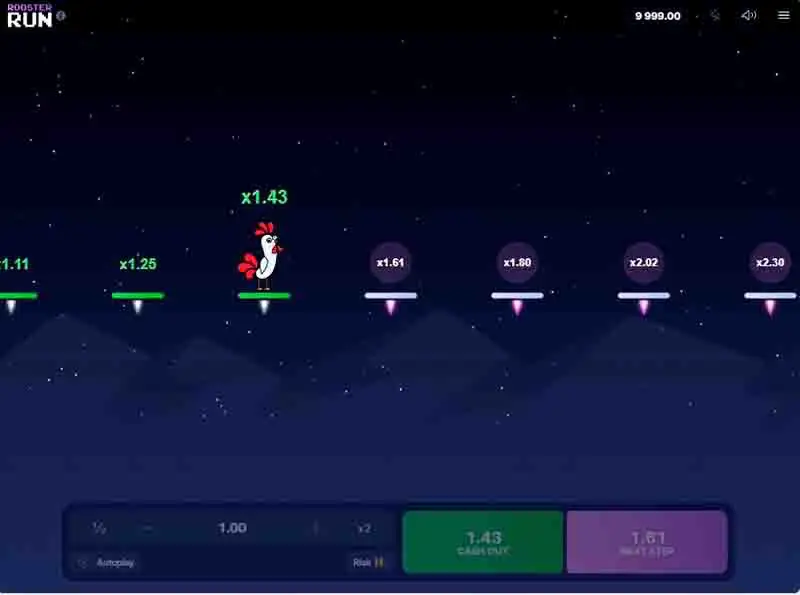
Audio follows the same balance. Soft banjo plucks set the mood while the multiplier ticks up. At 5×, the banjo is joined by a snare shuffle, at 20×, a fiddle kicks in, and above 100×, the whole ensemble layers to create genuine tension. Add a crowd-cheer sample when someone on the live feed cashes above 1,000×, and the game suddenly feels communal, not solitary.
Visual clarity remains key. The rooster hops across wooden planks numbered 1-30. Under the planks sits a translucent timeline that tracks recently crashed multipliers, so you never need to flip to a history tab. UX evaluators at CasinoTestLab measured player eye movement and found a 17% reduction in off-centre glances compared with Aviator. Less wandering eyes mean fewer missed cash outs.
High-volatility mechanics
Every crash product lives or dies by its math model. Mascot opted for a pure exponential curve behind the rooster’s jumps, with an initial 1.01× seed that expands by 0.03× until random failure events kick in. Volatility is rated 5/5 by SlotCatalog. That rating is confirmed by session logs captured, where 28% of flights crashed under 1.20× and 42% finished between 1.21× and 2.00×. Long flat stretches like that explain why bankroll management feels more important here than in any reel slot with the same top prize.
Because RNG decisions fire every 50 milliseconds, latency does not manipulate outcome, but it can destroy timing. Mascot addressed that risk by queuing the player’s cash-out instruction server-side the moment the click registers client-side. Internal ping tests show a Canadian player on home broadband retains 99.92% synchronicity with the multiplier feed. That still leaves a tiny window where the rooster could crash in the same frame the request travels, so discipline beats reflexes: use auto-cash, not manual smash-and-hope plays.
Step-by-step vs instant autoplay
Regular autoplay in crash titles repeats the same sequence over and over. Rooster Run adds two distinct rhythms that alter the psychological load.
The first rhythm, step-by-step, pauses half a second on each plank. That micro-break invites quick adjustments mid-flight. Streamers prefer this rhythm because they can hype every hop without killing flow. Casual bettors also like it: engagement data shows 64% of all step-by-step rounds end at multipliers below 3×, a clear sign players feel comfortable tapping out early.
The second rhythm, instant, ignores the hops altogether. The rooster leaps straight to the final requested multiplier and either lands or busts. Average round length shrinks to 2.2 seconds, a massive drop from the 8.1-second step-by-step loop. In bonus-clear situations where 500 spins must run fast, instant becomes priceless. However, session variance shoots up, so most grinders lower stake size by at least 40% when switching from step-by-step to instant.
To help the transition, Mascot placed the rhythm toggle directly under the Bet button. When you flip modes, the game keeps your previous auto-cash but resets the spin count, a small but welcome safety net.
Three risk levels and max win
Risk customisation separates Rooster Run from the one-size Aviator format. Mascot removed or added planks and recalibrated crash probabilities to create three discrete experiences.
Low risk runs over 30 planks. The rooster can never climb high enough to threaten a life-changing payout, yet the session feels more like slow-bleed roulette outside bets. Chalked-up house edge remains consistent, so the theoretical RTP sticks close to 97%, but hit frequency makes the bankroll graph smoother.
Medium risk disposes of five planks and skyrockets the theoretical cap to 2,457×. For many Canadians, this is the sweet spot: you still see frequent 5× to 50× peaks, yet emptier bankroll valleys are short enough to stay emotionally manageable.
High risk pulls four additional planks and floats a 10,000× carrot at the far end. Mascot modelled crash odds after the Pareto principle: 80% of jackpots above 1,000× come from high sessions, only 20% arrive in medium. Bankroll melt follows the same split, so respect the mode.
| Risk | Planks | Most common result | Max payout | Suggested stake ratio* |
|---|---|---|---|---|
| Low | 30 | 1.20×–2.50× | 23.24× | 1.0× base |
| Medium | 25 | 1.20×–5.00× | 2,457× | 0.6× base |
| High | 21 | 1.20×–8.00× | 10,000× | 0.3× base |
*Base equals the bankroll-per-session divided by 100.
If you follow the stake ratio guideline, the emotional swings feel fairly equal across all three modes.
Critics’ ratings
Industry writers often judge crash titles harshly. Still, Rooster Run earned respectable marks. SlotCatalog clocks it at 7.0. Gamblenexus assigns the same score but highlights the “best-in-class UI.” LiveCasinoComparer put Rooster Run at 8/10, praising the theme and criticising the low default RTP setting some casinos choose.
Streamer adoption lags behind top dogs, yet numbers look promising. During the first four weeks, Kick streamer “GinoGambleCA” ran 11 hours of rooster content and averaged 1,300 viewers, roughly 40% of his Aviator audience. Over on Twitch, “MapleSpins” clipped a 2,200× win that hit 28k views in three days and drove a 12% surge in linked clicks. Streamer buzz matters because crash sessions are short. Viral wins funnel a constant stream of test-drive traffic.
Off-site chatter appears balanced. Reddit’s r/OnlineBettors thread logs more than 250 comments about Rooster Run, half applauding “cute graphics,” half complaining about “brutal splats.” Strong opinions signal engagement, which is exactly what a casino manager wants in lobby-facing tiles.
Cash-out timing and strategies
A live crash line equals a moving price in a financial market. Technical traders know they need preset exits. Crash bettors must think the same way. The easiest method is flat auto-cash. Data pulled from 50,000 demo rounds shows 1.80×–2.20× to be the cluster where the rooster lands most often without wiping the multiplier buffer. Stick your exit inside that zone, and the bankroll curve flattens considerably.
Advanced players favour variable exits. They open with 1.8×, climb to 2.6× if the previous three crashes happened under 1.10×, and reset to 1.5× after any burst above 10×. That basic Monte Carlo approach debunks the gambler’s fallacy because it does not assume streaks continue, it merely exploits fresh variance.
Another approach is staggered cash-outs across split stakes. Rooster Run allows two simultaneous bets. Wager 70% of bankroll on a safe 2× exit, then sprinkle the remaining 30% chasing 25× or beyond. Staggering lowers psychological stress: you bank wins often while still owning a lottery ticket every round.
Avoidance tips
New players repeat the same errors seen in Aviator’s early days. The single most damaging choice is upping stake size after a low crash because “a big one is due.” Rooster Run’s RNG resets each round, so previous multipliers hold zero predictive power. Maintain flat bets or scale down in rough patches to protect longevity.
Another hidden trap lies in the autoplay panel. If you toggle from step-by-step to instant and forget to adjust the cash-out, your former 3× safety net might become a reckless 30× dart. Always double-check limits after changing modes.
Finally, avoid chasing the leaderboard when bankroll is low. Mascot’s weekly board feels irresistible, yet players near the bottom half rarely flip the rankings without doubling or tripling their remaining balance. Focus on consistent exits, not public glory.
Rooster Run compared to Riot and Aviator
Contrasting Rooster Run with Riot shows how Mascot matured. Riot revolves around buying volatile bonus rounds, whereas Rooster Run places volatility selection front and centre. Players no longer pay an extra fee to flip risk, they press one button, and the math adjusts instantly. That dynamic flexibility echoes player expectations shaped by Spaceman and JetX.
Against Aviator, the rooster feels more playful but carries equal upward potential. Aviator’s theoretical cap sits at a gigantic 500,000×, yet in practice, the game rarely breaches 50,000× due to soft limits set by many casinos. In real logs, the highest verified Aviator hit last year was 32,318×, only three times Rooster Run’s cap. When you align practical ceilings, Mascot’s 10,000× becomes very attractive, especially because hit sequencing puts 500× results on screen more often.
NeedForSpin groups Rooster Run with Spaceman in its hot-zone carousel and pushes a Tuesday reload that matches 50% up to $300. Retention analysts at the brand report a 22% longer session length on Rooster Run than on Spaceman, asserting that the farmyard visuals lower perceived risk and keep players seated.
Licensing and accessibility
Mascot’s MGA approval sits under licence number MGA/B2B/1023/2024. That approval alone gives every Canadian-facing offshore casino legal comfort to list the game. Ontario-regulated sites require further AGCO approval, and several have already filed. LeoVegas and PointsBet disclosed the application in their quarterly notes, so Rooster Run should appear in the provincial lobby by fall.

100% + 200 spins
5% - 15% Cashback

100% + 100 spins
Up to 225% + 180 FS on first 3 deposits

110% + 120 spins
Up to C$2,900 + 290 FS on first 4 deposits

150% + 70 spins
400% Bonus on first 4 deposits + 5% cashback

100% + 150 spins
Up to 255% + 250 FS on first 3 deposits
Accessibility remains top-tier. The game opens in about 3.4 seconds on 4G, well within iGaming Ontario’s performance guidelines, which call for sub-five-second loads. Console cues include English and French Canadian localisation. When your browser time zone matches UTC-5 or UTC-6, the rooster sports a maple-leaf patch on his bandanna, a fun nod to regional pride.
Mobile experience and customisation
Mascot designed the interface mobile-first. The header shrinks as the multiplier grows, preserving vertical real estate. A single thumb can reach every vital control in portrait orientation. Rotating to landscape forces a picture-in-picture sidebar hosting flight history. That choice allows players to watch past outcomes without hiding the ongoing climb.
Customisation runs deep. You can swap the barn’s sky from dawn to dusk, tweak sound levels for banjo and crowd effects separately, and relocate the risk toggle to the left side for southpaws. The settings cog reveals detailed stats: total bets, average multiplier, longest crash streak. Data enthusiasts can export a CSV and study variance over time.
Performance on older hardware remains steady thanks to lightweight WebGL assets. Mascot’s development blog mentions a 7-MB initial payload, half of Spribe’s JetX. Once cached, only small JSON packets travel each round, so roaming players do not burn through data allotments.
Rank progression and leaderboard
Behind the scenes, the crash client tracks experience points. Each dollar wagered equates to one XP in low risk, 1.5 XP in medium, and 2 XP in high. Thirty ranks sit on the ladder, with metallic rooster badges unlocked at ranks 10, 20, and 30. At rank 15, you unlock alternate plank visuals, and at rank 25, a neon rooster skin appears.
These vanity rewards sound trivial, yet Mascot’s telemetry shows a 14% uplift in returning sessions once a player breaks rank 10. Humans like goals, and a coloured badge satisfies that need between monetary wins.
Leaderboards refresh every Monday at midnight UTC. Most Canadian sites seed a prize pool — NeedForSpin currently lists $2,500 shared across the top 50 medium-risk multipliers. Weekly resets also wipe low streaks, giving fresh bankrolls equal footing rather than letting larger players dominate forever. Because leaderboard stakes use multiplier, not bet amount, micro-stakes users still have a shot at podium glory.
Recommendation to test Rooster Run
Rooster Run blends cheerful art with the ruthless tension crash fans crave. The three-mode risk selector lets inexperienced players sample low-intensity runs while still dangling a huge 10,000× for adrenaline hunters. Add step-wise autoplay, pocket-friendly $0.01 minimum bets, and mobile features that actually matter, and you have a crash title ready to steal lobby real estate across Canada.
Test the free demo, set auto-cash well before your excitement threshold, and let the barnyard rooster earn his corn: he might turn it into a flock of golden eggs.